.png?width=1050&height=450&name=email%20signature%20(4).png "email signature (4)")
The next step is to schedule a discovery session so we can understand your risk management needs in more detail.
Public Sector Organization
The Government of Nunavut is responsible for managing risk, insurance, and claims across multiple departments, assets, and communities spread throughout Canada’s northernmost territory. The central risk management function supports departments such as Health, Education, Infrastructure, and Community Services, while also meeting stringent government reporting, audit, and insurer requirements. The risk team is responsible for processing, managing, and reporting on 180+ claims annually.
Challenges
Before ClearRisk, Nunavut’s risk management team relied on manual, siloed systems that limited reporting, visibility, and proactive risk mitigation. Answering questions often required significant manual effort, and meaningful cross-department or cross-community insights were difficult to obtain.
Solution
ClearRisk’s cloud-based risk and claims management platform centralized Nunavut’s data, automated reporting, and enabled the team to analyze incidents, claims, and financials across departments and communities which supports faster decisions and more proactive risk management.
%20(72%20x%2025%20in)-4.png?width=2000&height=694&name=Copy%20of%20case%20study%20quotes%201%20(72%20x%2030%20in)%20(72%20x%2025%20in)-4.png "Copy of case study quotes 1 (72 x 30 in) (72 x 25 in)-4")
Challenges
Before ClearRisk, Nunavut’s claims and incident data was organized primarily by insurance policy rather than by community or department. While this approach supported basic record keeping, it made it extremely difficult to identify trends or connections across the organization.
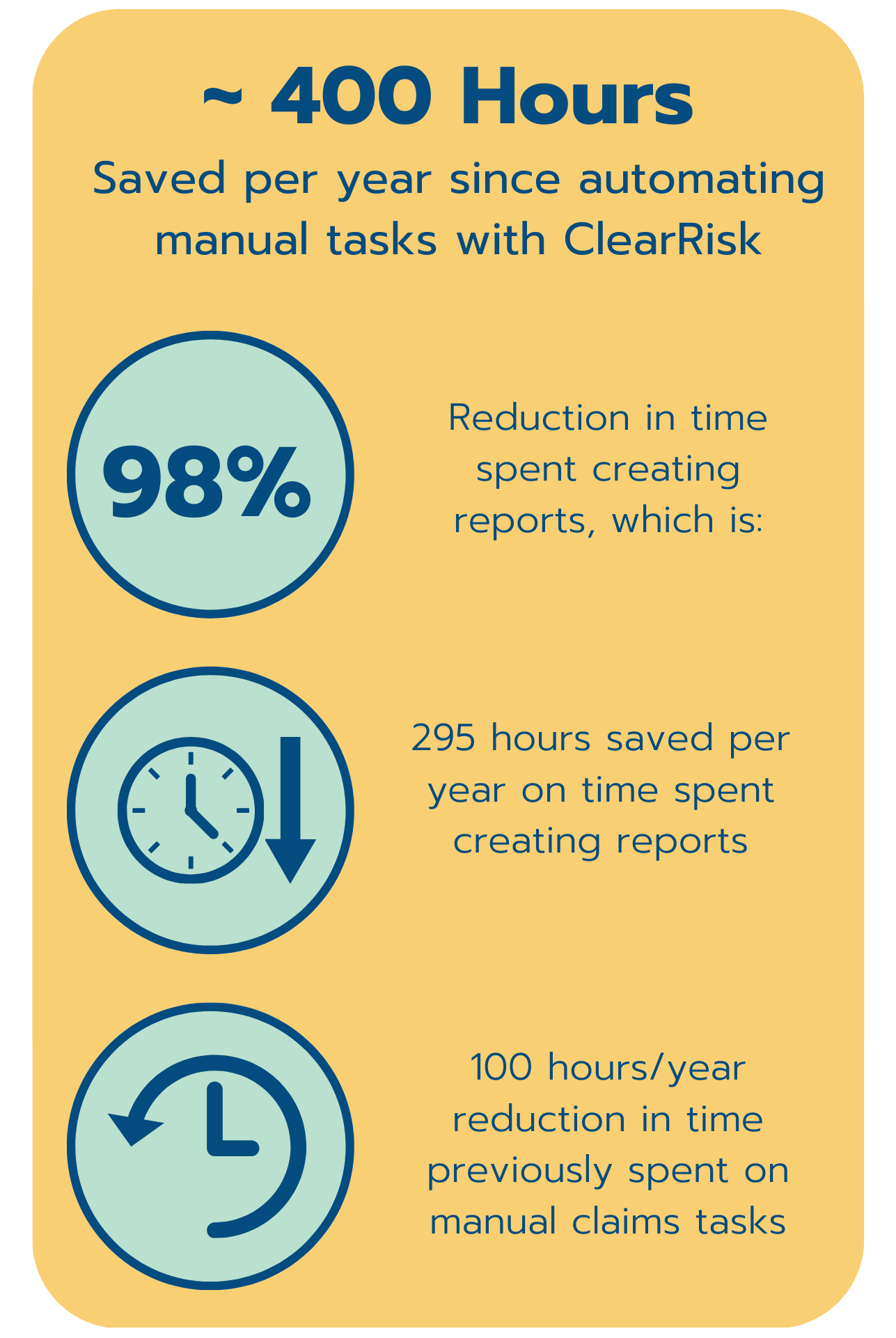
Every request for insight into a claim or incident across all departments required manual effort. Incident documentation was a manual process that took about 30 minutes per claim. With approximately 180 annual claims that is more than 90 hours per year spent manually entering claims data.
Reports could not be saved or set to update automatically, meaning the same work was repeated every time a question arose. Producing a single ad hoc report often took five hours or more, especially when the request required reviewing underlying claim details or financial information. With approximately 60 reports a year, that is more than 300 hours spent on reporting annually.
“A report that takes me five minutes to generate in ClearRisk would have taken
five hours before — and you’d still be missing information.”
- Sarah Morton, Manager, Risk Management
Because of these limitations, many insights were simply inaccessible. Identifying repeat incidents or understanding when multiple departments were impacted by the same event often relied on individual memory rather than reliable data.
Financial reporting added another layer of complexity. Insurance payments had to be tracked and reported as part of government accounting, and audit requests often meant pulling physical files and manually verifying details.
Overall, the team spent more time finding and preparing information than analyzing it, leaving little opportunity to proactively manage risk.
Solution
ClearRisk provided Nunavut with a centralized, cloud-based system that brought claims, incidents, and financial data into one place, supported by automated, always-up-to-date reporting. Instead of rebuilding reports from scratch, the team now uses saved dashboards and reusable report templates. Reports for insurer renewals, audits, and internal requests are pre-built and only require date updates.
“We’ve already pre-done our reports for renewals. We just update the dates — that’s it.”
- Sarah Morton, Manager, Risk Management
Reports that once took hours to compile can now be generated in minutes, resulting in time savings of more than 98%, allowing the team to focus on analysis rather than data collection. ClearRisk also helps maintain better data hygiene by making it easy to identify missing or incomplete information.
ClearRisk has significantly improved visibility into patterns that were previously hidden. Claims linked to the same individual can now be flagged during intake, helping analysts decide when to take a closer look. The team can also view incidents by community and date, revealing when multiple departments are impacted by a single event, something that previously would have gone unnoticed.
“We saw three departments had incidents on the same day in the same community.
Before, the only way we would have known that is if one person remembered it.”
- Sarah Morton, Manager, Risk Management
With these insights, Nunavut’s risk team has been able to shift from reactive reporting to proactive risk mitigation. ClearRisk data has been used to identify increases in vandalism or threats in certain communities, allowing the team to make preventative recommendations such as improved lighting or additional security.
Financial transparency has also improved significantly. Insurance payments are now clearly tracked and easy to share with finance teams and auditors. In some cases, ClearRisk reports have been shared directly with department leaders to support funding requests.
ClearRisk has also strengthened insurer relationships. During renewals, the team is able to provide comprehensive, consistent reports that insurers trust. Insurers have responded positively to the improved clarity and consistency of reporting, and Nunavut has already seen premium decreases since implementing ClearRisk.
“We’ve been through renewals using ClearRisk reports, and our insurers love it.”
- Sarah Morton, Manager, Risk Management
Results
- 100 hours/year reduced in time previously spent on manual claims tasks such as manual data entry, task management and correspondence with internal and external stakeholders
- Ad hoc reports reduced from ~5 hours to minutes, resulting in 98% reduction in time spent reporting
- Improved visibility into repeat incidents and investigation flags
- Cross-department and cross-community insights that were previously unavailable
- Reduction in insurance premiums
- Faster, clearer government and audit reporting
- Data-backed recommendations that supported security funding approvals
- Stronger insurer renewals supported by higher-quality reporting
- Reduced reliance on physical files and institutional knowledge
- More time spent on proactive risk mitigation rather than reactive data gathering
Request a demo
ClearRisk 2025. This case study constitutes proprietary information of ClearRisk. No part of this case study may be reproduced, transmitted, transcribed stored in a retrieval system or translated into any language in any form without the written permission of ClearRisk. ClearRisk reserves the right to make changes in this case study at any time and without notice. ClearRisk makes no warranties, expressed or implied in this case study. The topics discussed in this case study are broad in scope and situations can differ greatly in legal jurisdictions, different industries, and different companies.
Interested in learning more?
Let’s Chat.
